

Trauma Counseling in Scottsdale, AZ
Trauma can affect your emotions, body, relationships, confidence, and sense of safety long after an experience ends. Counseling can help you understand those reactions, reduce shame, and develop greater awareness, regulation, connection, and choice.
Trauma Can Leave Lasting Traces
People are capable of surviving extraordinary hardship. Throughout history, people have endured war, disaster, violence, loss, and betrayal—and many have found ways to rebuild their lives. But surviving an experience does not necessarily mean that its effects are over. Trauma can continue influencing how a person feels, relates to others, experiences closeness, and responds to the world around them.
Many people cope by pushing painful memories aside and trying to continue as though nothing happened. They may remain productive, care for their families, succeed professionally, and appear composed to others. Underneath that outward functioning, however, it can take enormous emotional and physical energy to contain fear, shame, vulnerability, and memories that still feel unbearable.
The brain’s survival system is designed to respond quickly to possible danger. Long after a traumatic experience has ended, that protective system may still become activated by a tone of voice, facial expression, smell, place, conflict, physical sensation, or feeling of helplessness. The reaction may occur before the person consciously understands what triggered it.
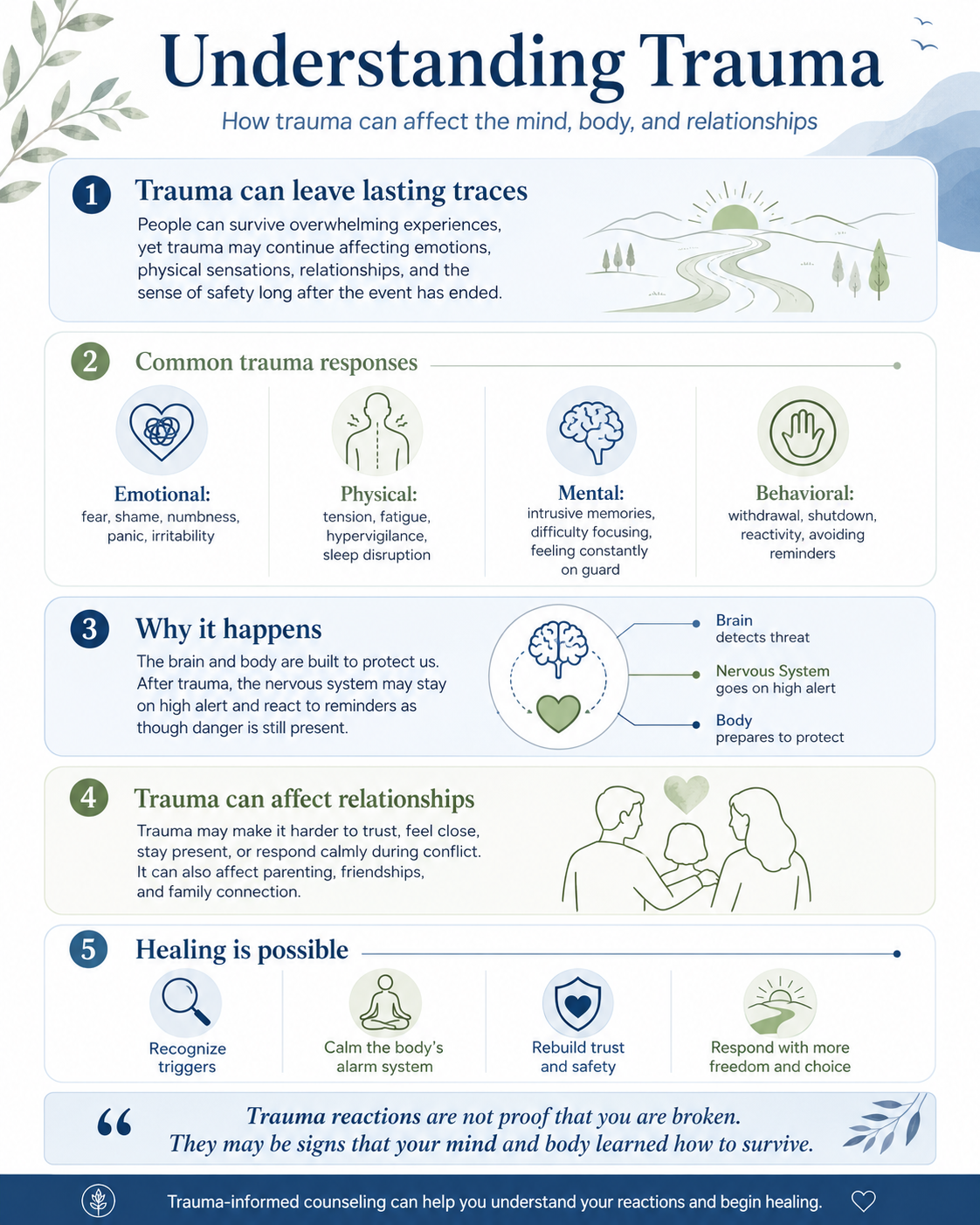
When this happens, someone may suddenly experience intense fear, anger, panic, numbness, physical tension, or an urgent need to escape or defend themselves. They may withdraw emotionally, become unusually reactive, shut down during conflict, or act in ways that do not seem to match the present situation.
These responses can feel confusing because the person may logically know they are safe while their body and emotions respond as though the past is happening again.
Trauma can also affect the people closest to the person who experienced it. Emotional withdrawal, irritability, distrust, fear, or difficulty being fully present may place strain on partnerships, parenting, friendships, and family relationships. When violence, secrecy, instability, or emotional absence are part of family life, the effects may influence how later generations understand safety, intimacy, trust, and emotional connection.
People living with these reactions often begin to fear that something is fundamentally wrong with them. They may feel damaged, ashamed, out of control, or beyond help. In reality, many trauma responses began as ways of surviving an overwhelming experience. The problem is not that the mind and body learned to protect the person—it is that those protective responses may continue operating after the danger has passed.
Trauma counseling can help you understand these reactions without judging or blaming yourself. Through carefully paced, trauma-informed support, you can begin recognizing triggers, calming the body’s alarm system, rebuilding trust in yourself, and responding to present-day situations with greater freedom and choice.
Trauma reactions are not proof that you are broken. They may be signs that your mind and body learned how to survive something overwhelming. Healing can help those survival responses become less controlling so that the past no longer determines the present.
Trauma Can Recalibrate the Brain’s Alarm System
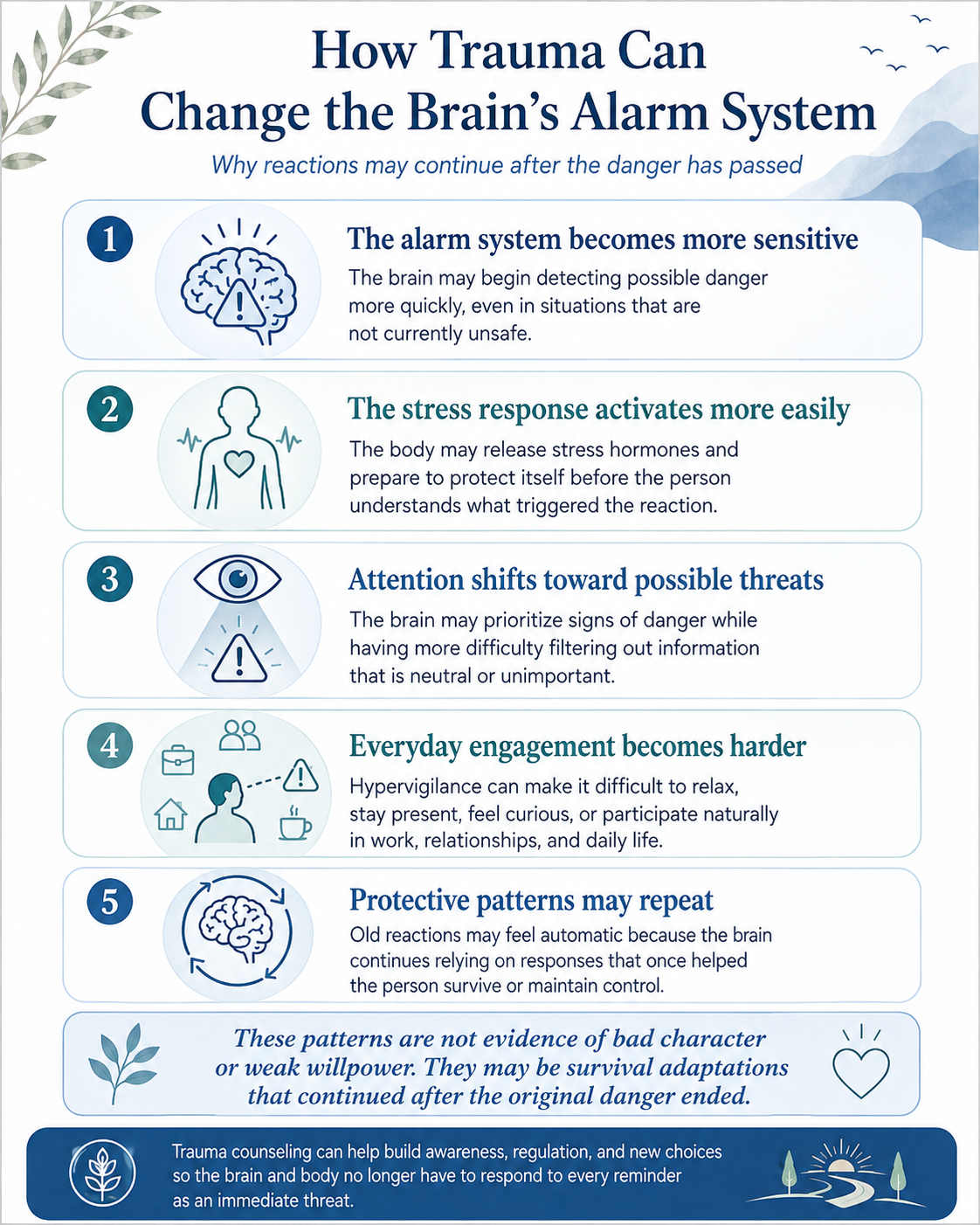
Research across neuroscience, physiology, and related fields has shown that trauma can affect systems involved in detecting danger, regulating stress, and deciding what deserves attention.
After an overwhelming experience, the brain’s alarm system may become more sensitive. Stress responses may activate more easily, and the brain may have greater difficulty separating information that is important in the present from information that can safely be ignored.
As a result, a person may become highly alert to possible threats while finding it harder to relax, remain present, or engage naturally in everyday life. Attention may be pulled toward signs of danger even when the current situation is not truly unsafe.
These reactions can happen quickly and automatically. Someone may feel tense, defensive, overwhelmed, emotionally numb, or compelled to escape before they have time to understand why the situation feels so threatening. The thinking part of the brain may recognize that the danger has passed, while protective systems continue responding as though immediate action is still necessary.
Why the Same Patterns May Keep Repeating
Trauma-related reactions can help explain why a person may repeatedly return to the same behaviors, relationships, or coping patterns—even when they understand that those patterns are no longer helping them.
Insight alone may not immediately change a response that developed during an overwhelming experience. The brain may continue relying on familiar protective patterns because those responses once helped the person survive, avoid danger, or maintain some sense of control.
These Reactions Are Not Character Flaws
This does not mean the person lacks intelligence, motivation, discipline, or willpower. It does not mean they have poor character or are choosing to remain stuck. Trauma can change how a person identifies possible danger, processes information, and prepares to respond.
Understanding these responses can reduce shame and create a more compassionate starting point for healing. Instead of asking, “What is wrong with me?” a person can begin asking, “What did my mind and body learn to do in order to survive?”
Trauma-related behaviors are not signs of weak character. They may be protective responses shaped by a mind and body that learned to remain prepared for danger.
When Trauma Makes It Hard to Feel Safe in Your Own Body
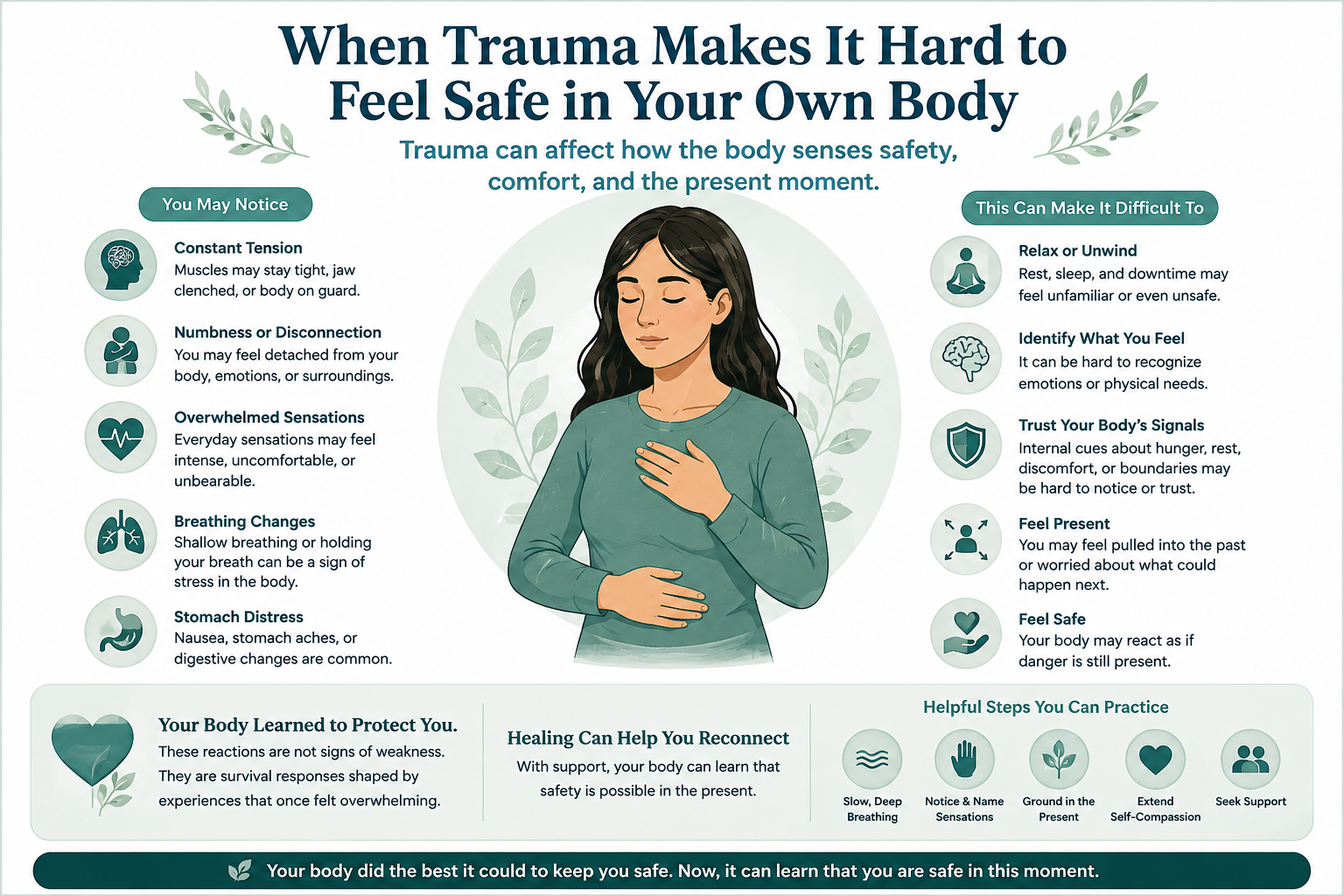
Trauma can affect the connection between physical sensations, emotions, and a person’s sense of self. Some people become highly aware of every heartbeat, muscle shift, or change in breathing. Others cope by disconnecting from physical sensations and emotional needs because noticing them once felt overwhelming or unsafe.
You may ignore exhaustion, tension, hunger, pain, or the need for rest until your body becomes difficult to ignore. You may also struggle to identify what you are feeling, recognize when a boundary has been crossed, or trust the internal signals that ordinarily help guide decisions.
Feeling detached, numb, or disconnected does not mean you do not care. It may be a protective response that helped reduce the intensity of an experience that felt impossible to tolerate at the time.
Healing often includes learning to notice sensations and emotions in manageable amounts, without judgment and without becoming overwhelmed. The goal is not to force awareness. It is to gradually rebuild a safer and more reliable connection with yourself.
Physical Sensations
- Muscle tension or restlessness
- Racing heart or shallow breathing
- Stomach discomfort
- Sleep disruption or fatigue
Disconnection
- Feeling numb or detached
- Difficulty naming emotions
- Moving through life on autopilot
- Not noticing physical needs
Reconnection
- Grounding in the present
- Recognizing early warning signs
- Naming emotions and needs
- Responding with greater choice
Why Trauma Triggers Can Feel So Immediate
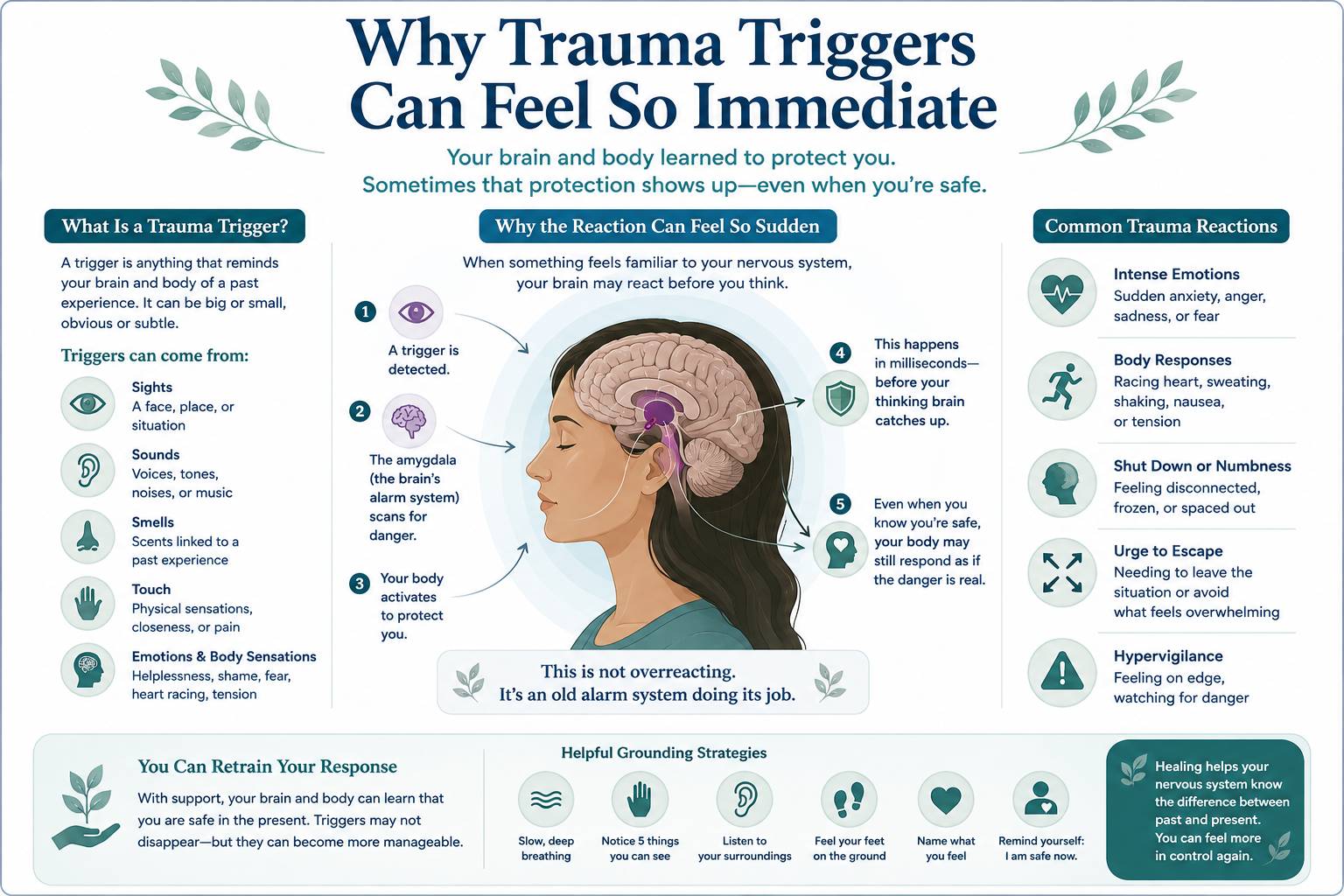
A trauma trigger is not always an obvious reminder of what happened. It may be a facial expression, tone of voice, smell, date, location, physical sensation, conflict, silence, or moment in which a person feels trapped, powerless, rejected, or unable to control what happens next.
The protective response may begin before the person consciously connects the present situation with the past. The body may tighten, attention may narrow, and emotions may intensify within seconds. This is one reason trauma reactions can feel sudden and difficult to explain.
A trigger does not mean the present situation is identical to the original experience. It means something in the present activated a protective association connected to past danger, helplessness, loss, or betrayal.
Trauma counseling can help you identify patterns, notice activation earlier, orient to the present, and develop responses that fit what is happening now rather than what happened before.
Possible Sensory Triggers
Sounds, smells, lighting, locations, physical sensations, facial expressions, or unexpected touch.
Possible Relational Triggers
Conflict, criticism, silence, withdrawal, feeling dismissed, losing control, or fearing abandonment.
Present-Focused Support
Orienting to time and place, grounding through the senses, noticing the body, and seeking safe support.
How Trauma Can Affect Everyday Life
Trauma does not remain contained in a memory. Its effects may appear in ordinary moments—during a conversation, at work, while trying to sleep, when making a decision, or when someone offers closeness and support.
Some people become perfectionistic, overprepared, or constantly busy because slowing down allows uncomfortable feelings to surface. Others avoid decisions, conflict, relationships, places, or responsibilities connected to fear and overwhelm.
These patterns can make daily life feel smaller, more exhausting, or less spontaneous. Counseling can help you understand what the pattern is trying to protect you from and develop more flexible ways of responding.
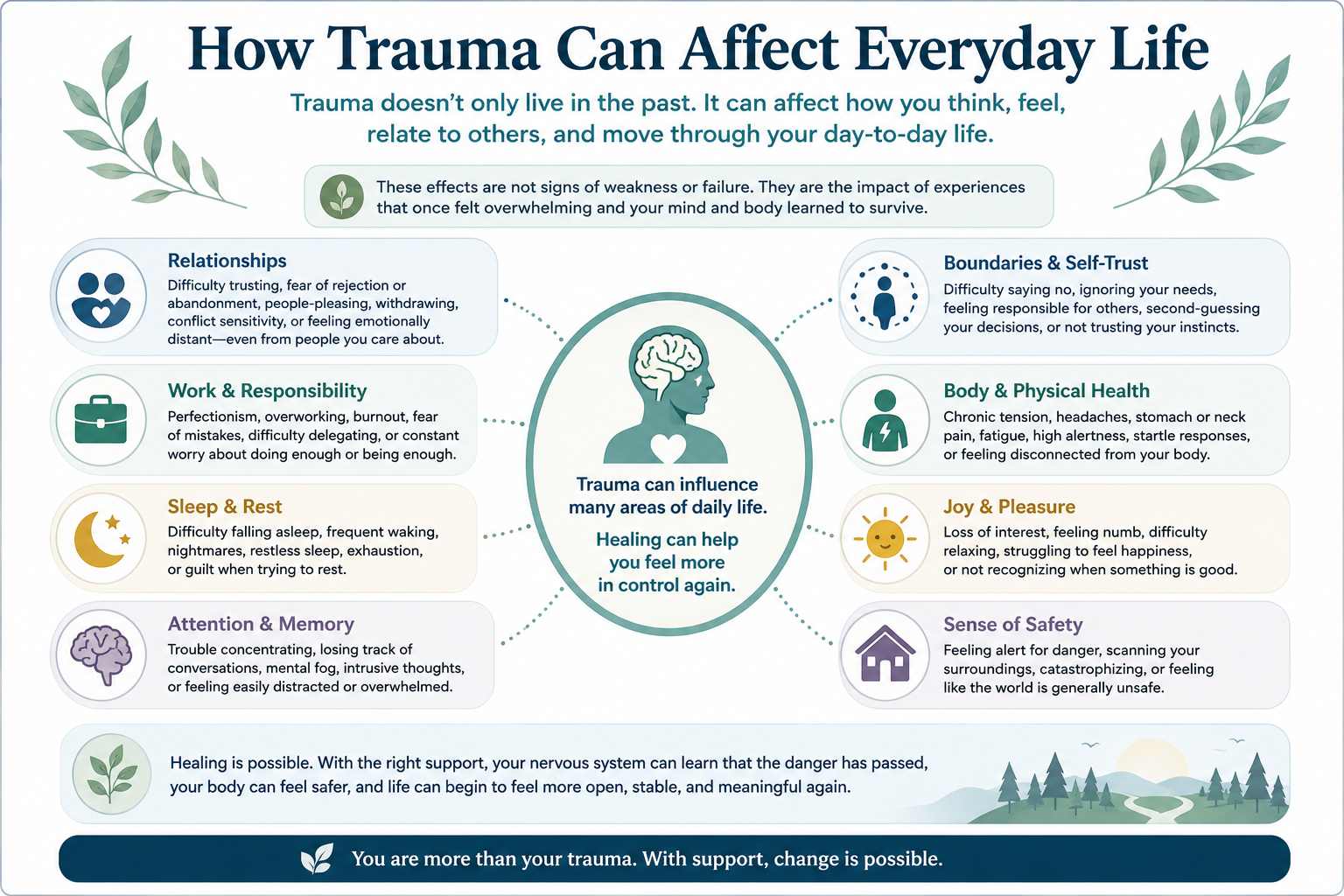
Relationships
Difficulty trusting, fear of abandonment, people-pleasing, withdrawal, conflict sensitivity, or emotional distance.
Work and Responsibility
Perfectionism, overworking, burnout, fear of mistakes, difficulty delegating, or always preparing for the worst.
Sleep and Rest
Difficulty falling asleep, frequent waking, nightmares, restless sleep, exhaustion, or guilt when resting.
Attention and Memory
Trouble concentrating, losing track of conversations, mental fog, intrusive thoughts, or attention pulled toward possible danger.
Boundaries and Self-Trust
Difficulty saying no, doubting your judgment, ignoring discomfort, or feeling responsible for everyone else’s emotions.
Joy and Presence
Feeling detached, unable to relax, emotionally flat, guilty when happy, or unable to remain present during positive experiences.
How Trauma Can Affect Trust, Connection, and Relationships
Close relationships require vulnerability, trust, communication, and the ability to remain emotionally present. Trauma can make each of those experiences feel risky—even when the relationship itself is caring and safe.
Some adults protect themselves by remaining distant, independent, or emotionally guarded. Others become highly sensitive to signs of rejection, conflict, abandonment, or betrayal. A person may alternate between wanting closeness and feeling overwhelmed once closeness is available.
People-pleasing, difficulty setting boundaries, shutting down during conflict, becoming intensely reactive, or repeatedly choosing familiar relationship dynamics may all have roots in earlier efforts to preserve safety, attachment, or control.
These patterns are not destiny. Counseling can help you recognize what feels familiar, understand what activates fear, strengthen boundaries, communicate needs, and experience connection without automatically losing your sense of self.
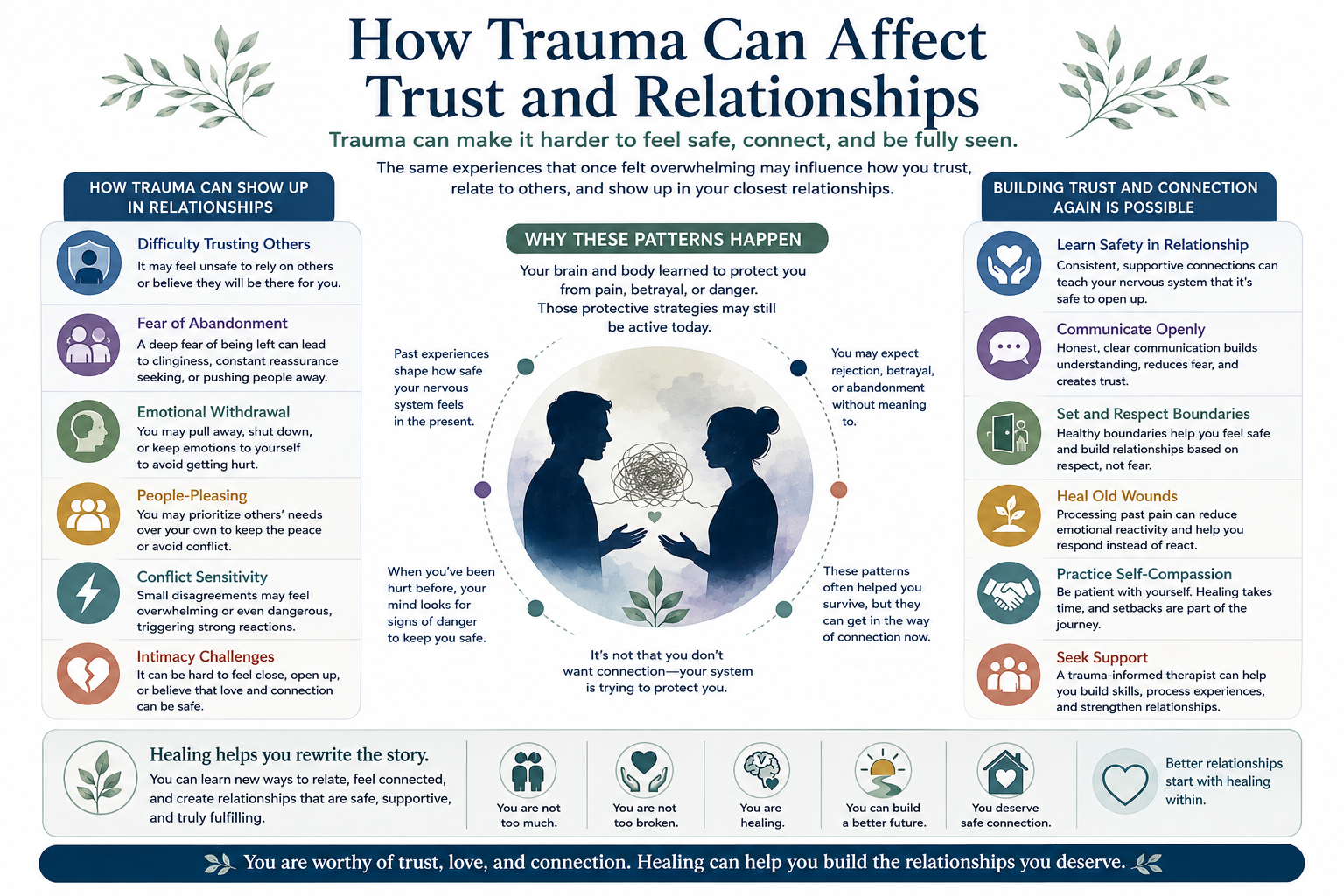
Protective relationship patterns often began for a reason. Healing is not about judging those patterns. It is about understanding them and building safer ways to stay connected to yourself and others.
Why Trauma Survivors May Blame Themselves
Self-blame can create the illusion that the experience could have been prevented if the person had acted differently, noticed sooner, fought harder, left earlier, or been stronger. Although painful, that explanation can sometimes feel less frightening than recognizing how little control the person had during an overwhelming event.
Shame may also develop when survival responses are misunderstood. Freezing, complying, shutting down, becoming numb, or remaining attached to someone unsafe can be judged afterward as weakness. In the moment, however, these reactions may have reflected the nervous system’s effort to reduce danger, preserve connection, or endure what could not be escaped.
Trauma counseling can help separate responsibility from survival. It can also help you examine beliefs such as “I should have known,” “I caused this,” “I am damaged,” or “I cannot trust myself” with greater accuracy and compassion.
A more compassionate question is not only, “Why did I react that way?” It is also, “What was that reaction trying to help me survive?”
When Trauma Leads to Numbness or Disconnection
Not every trauma response looks anxious or visibly distressed. Some people feel emotionally flat, detached from their bodies, unreal, distant from others, or as though they are observing life rather than fully participating in it.
Numbness and disconnection can make it possible to continue functioning when emotions feel too intense. A person may complete responsibilities, care for others, and appear calm while feeling absent or disconnected inside.
Counseling should not force someone out of a protective state before they have enough support and stability. Healing may begin with brief, manageable moments of noticing—recognizing a sensation, naming an emotion, orienting to the room, or allowing safe connection without becoming overwhelmed.
Healing Helps Restore Safety, Connection, and Choice
Healing does not require forgetting what happened or pretending that it no longer matters. It means the experience becomes less able to control your body, relationships, decisions, and sense of identity in the present.
Over time, you may learn to notice activation sooner, recover more quickly after a trigger, recognize what you need, communicate more clearly, and make decisions based on current reality rather than old survival expectations.
Progress is not always linear. Periods of stress, loss, conflict, or change can reactivate old responses. That does not erase the work you have done. It may be an opportunity to understand what still needs support and strengthen the skills that help you return to the present.
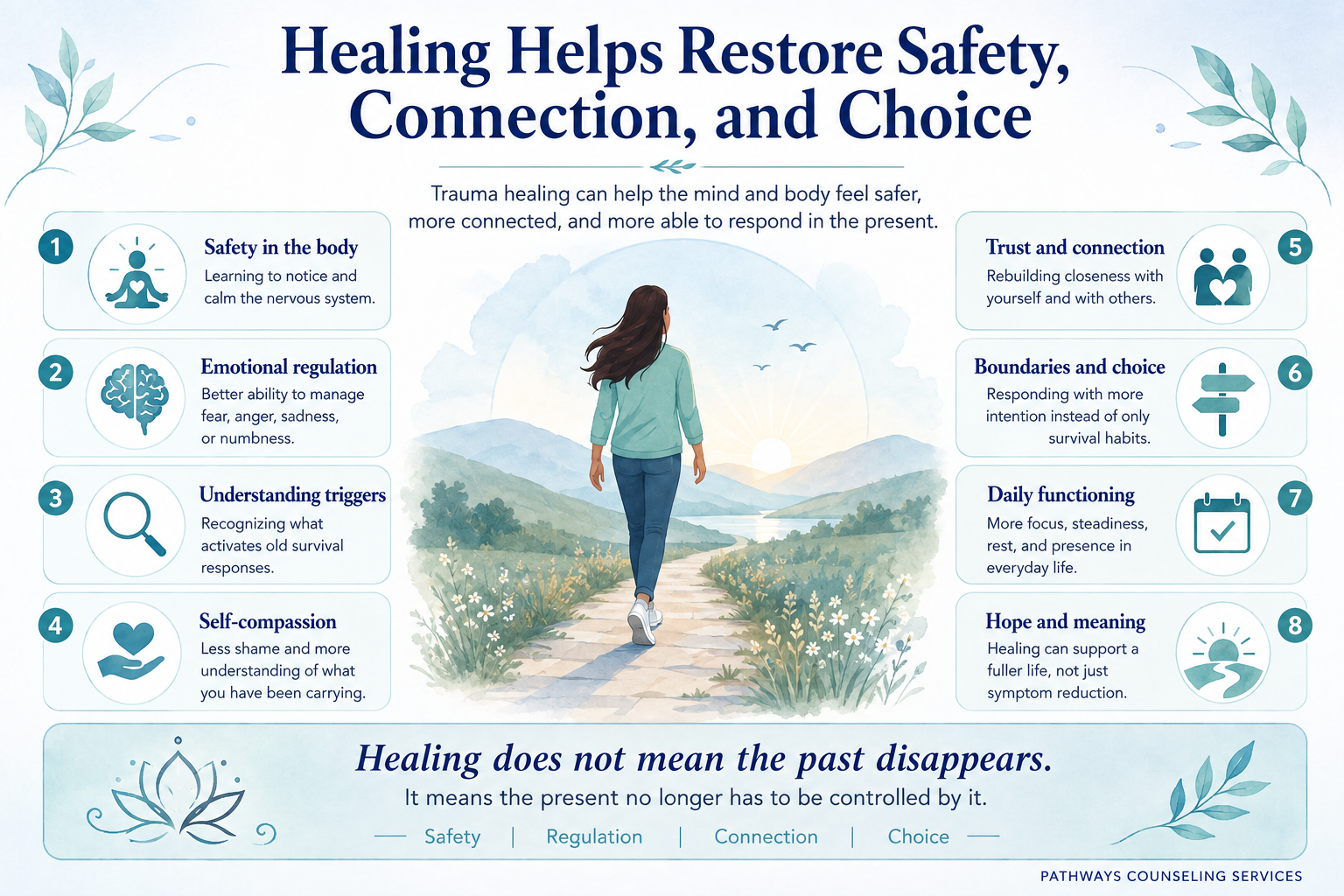
Greater Awareness
Recognizing triggers, body signals, emotions, and protective patterns sooner.
More Regulation
Recovering more quickly after activation and staying connected to the present.
Stronger Boundaries
Identifying needs, saying no, and protecting your time, body, and emotional well-being.
Safer Connection
Communicating more openly and experiencing closeness without automatically losing yourself.
More Self-Trust
Believing your perceptions, making decisions, and relying less on fear or shame.
Greater Choice
Responding to present-day situations rather than automatically repeating past survival patterns.
What Happens in Trauma Counseling?
Trauma counseling should begin with understanding, safety, and preparation—not immediate pressure to revisit painful experiences. The exact process is individualized, but treatment may include the following stages.
Understanding What Is Affecting You Now
Your therapist learns about current concerns, relationships, symptoms, strengths, goals, and the patterns you want to change.
Building Safety and Stability
Treatment may begin with grounding, emotional regulation, boundaries, sleep support, anxiety management, and recognizing early signs of activation.
Recognizing Trauma-Related Patterns
You may explore how past experiences influence beliefs about safety, trust, control, responsibility, relationships, or self-worth.
Processing Difficult Experiences When Appropriate
Once enough trust and stability are present, therapy may help you process memories, emotions, beliefs, or body-based reactions at a manageable pace.
Applying Healing to Daily Life
Progress may include stronger boundaries, improved communication, greater self-trust, safer relationships, and more freedom in present-day decisions.
Trauma-Informed Approaches We May Use
Treatment is tailored to your needs, symptoms, preferences, history, and readiness. Not every client needs every approach.
Trauma-Informed Counseling
Emphasizes safety, trust, collaboration, informed choice, and careful pacing.
Cognitive Behavioral Therapy
May help examine fear-based beliefs, avoidance, self-blame, and coping patterns connected to difficult experiences.
EMDR Therapy
May be considered when memories, triggers, or negative beliefs continue to feel emotionally active.
Grounding and Mindfulness
Can support present-moment awareness and help you notice activation without becoming as overwhelmed.
Emotional-Regulation Skills
Can help identify emotions, tolerate distress, and respond more intentionally during difficult moments.
Relational Support
May address trust, communication, boundaries, closeness, conflict, and patterns shaped by earlier relationships.
Trauma Self-Reflection
This is not a diagnosis. It is a starting point for noticing patterns that may be worth discussing with a qualified mental-health professional.
Identifying with one or more statements does not automatically mean you have PTSD or another diagnosis. A therapist can help you understand your individual experience and discuss appropriate options.
Meet Our Trauma Therapists in Scottsdale
Our team provides trauma-informed support for adults affected by childhood experiences, relationship trauma, loss, accidents, medical experiences, intrusive memories, anxiety, emotional shutdown, and other overwhelming life events.
We can help match you with a therapist whose clinical experience, treatment approach, availability, and personality fit your needs.
Frequently Asked Questions About Trauma Counseling
Do I need a PTSD diagnosis to receive trauma counseling?
No. Many people seek trauma counseling because past experiences affect their emotions, relationships, boundaries, body, or sense of safety even though they have not received a PTSD diagnosis.
Do I have to describe every detail of what happened?
No. Trauma counseling should move at a pace that supports safety and choice. Your therapist can help you build trust and regulation skills before discussing or processing difficult experiences.
Can childhood experiences still affect me as an adult?
Yes. Childhood abuse, emotional neglect, instability, loss, criticism, or chronic family stress can influence adult relationships, self-worth, boundaries, emotional regulation, and the ability to feel safe.
Can trauma affect physical sensations and sleep?
Trauma-related stress may be associated with tension, racing heart, stomach discomfort, shallow breathing, restlessness, sleep disruption, or feeling constantly on alert. A therapist can help you consider these symptoms in the context of your full history and needs.
Is EMDR always part of trauma counseling?
No. EMDR is one possible treatment method. Trauma counseling may also include CBT, grounding, mindfulness, emotional-regulation skills, relational work, or other approaches based on your goals and readiness.
Can trauma counseling help with relationship problems?
It may help when past experiences influence trust, boundaries, communication, fear of abandonment, emotional shutdown, conflict, or difficulty feeling safe in close relationships.
How long does trauma counseling take?
The length of therapy depends on your experiences, current symptoms, goals, support system, and readiness. Your therapist will review progress with you and adjust the treatment plan when needed.
Is trauma counseling available through telehealth?
Pathways offers secure telehealth for clients located in Arizona when virtual care is clinically appropriate, as well as in-person appointments at the Scottsdale office.
Do you accept insurance?
Pathways is a private-pay practice and does not bill insurance directly. Superbills may be available for clients whose plans include out-of-network mental-health benefits. Review current information on the therapy fees and rates page.
Sources and Further Reading
This educational page draws on trauma-informed clinical principles and the themes you supplied from The Body Keeps the Score. The website copy is original Pathways content rather than copied book text.
- The Body Keeps the Score by Bessel van der Kolk, M.D.
- National Institute of Mental Health: Post-Traumatic Stress Disorder
- National Institute of Mental Health: Coping With Traumatic Events
- SAMHSA: Trauma-Informed Approaches and Programs
- National Center for PTSD: How PTSD Can Affect Families
Educational information is not a diagnosis and is not a substitute for individualized care from a qualified mental-health professional.
You Do Not Have to Keep Living in Survival Mode
Past experiences may be part of your story, but they do not have to keep controlling your body, relationships, confidence, or ability to feel safe. Trauma counseling can help you understand what is happening beneath the surface and move toward greater stability, self-trust, connection, and choice.